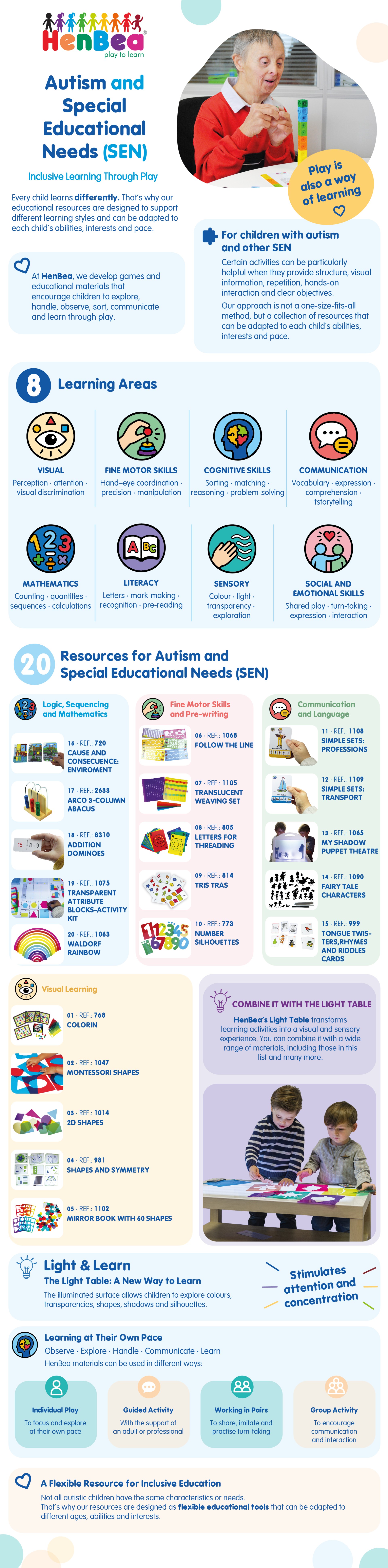
Eight areas for organising activities
Every child learns differently. This newsletter brings together play resources for exploring, handling, observing, sorting and communicating. Start with individual interests, pace and needs, with adult support when the activity requires it.
- Visual: observe colours, shapes and differences.
- Fine motor skills: handle, fit and thread pieces.
- Cognitive activities: sort, match and explore problems.
- Communication: name, describe and tell stories.
- Mathematics: count, compare quantities and follow sequences.
- Literacy: explore letters and practise marks.
- Sensory exploration: investigate colour, light and transparency.
- Social and emotional activities: share play, take turns and express ideas.
The 20 resources shown in the poster
Visual learning
- Colorín · 768
- Montessori shapes · 1047
- 2D shapes · 1014
- Shapes and symmetry · 981
- Mirror book with 60 shapes · 1102
Fine motor skills and pre-writing
- Follow the line · 1068
- Translucent weaving set · 1105
- Letters for threading · 805
- Tris tras · 814
- Number silhouettes · 773
Communication and language
- Simple sets: professions · 1108
- Simple sets: transport · 1109
- My shadow puppet theatre · 1065
- Fairy tale characters · 1090
- Tongue twisters, rhymes and riddles cards · 999
Logic, sequencing and mathematics
- Cause and consequence: environment · 720
- Arco three-column abacus · 2633
- Addition dominoes · 8310
- Transparent attribute blocks activity kit · 1075
- Waldorf rainbow · 1063
The light table as an additional resource
An illuminated surface offers a way to observe colours, transparency, shapes and silhouettes. Some translucent materials in the poster can be combined with a light table. Other activities, such as using stencils or threading, can take place without one. Check the material instructions and activity setup.
Choose the activity and pace
Materials can be used individually, with adult guidance, in pairs or in a group. Introduce a clear activity and adapt the number of pieces, steps and duration to the child’s participation. A diagnosis alone does not determine preferences or the choice of materials.
Explore materials and activity guides for children with autism
View the original newsletter poster